Find out what you can get up to in Liverpool this week here 🤩



Culture
How often have you walked past this fascinating piece of history on Castle Street?
3 hours ago
Anyone walking down Castle Street today’s often side-tracked by the bars and restaurants that fill this busy part of the city or the beautiful old buildings that line the road right up to the town hall.
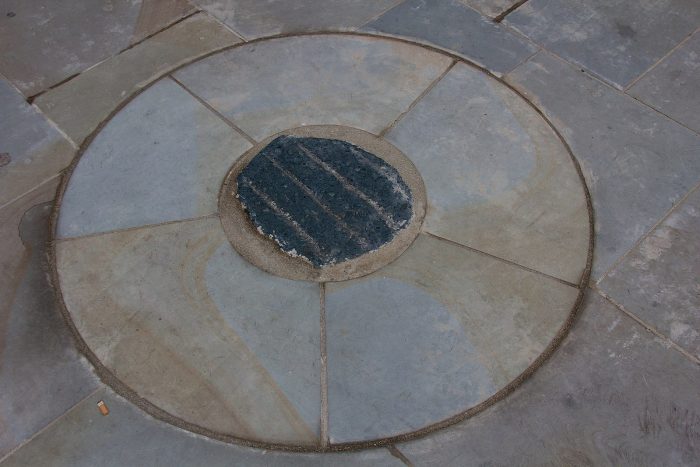
But while we’re so engrossed in them, loads of us are missing a fascinating piece of Liverpool history that’s right in front of our eyes or, rather, beneath our feet!
The Sanctuary Stone is a circular marker that once defined the boundary of the medieval markets and fairs granted by King John and, while it was originally one of four – there were thought to be others on High Street (once Juggler Street), Water Street and Dale Street – it’s the only one that’s survived.
You can find it in the pavement just outside the old Nat West Bank at number 22 Castle Street – just across the road from San Carlo – where there’s now a blue plaque to celebrate its existence.
Liz Stewart, head of the Museum of Liverpool said: “There’s a lot of very good and very distracting architecture on Castle Street, so I understand why people look up. But as an archaeologist, I’ve always been taught to look down and into all those holes being dug into the ground to see what’s going on down there.
“The Sanctuary Stone is a really special bit of early Liverpool history which there’s not a lot of evidence of, so to have that as a survivor is wonderful.”
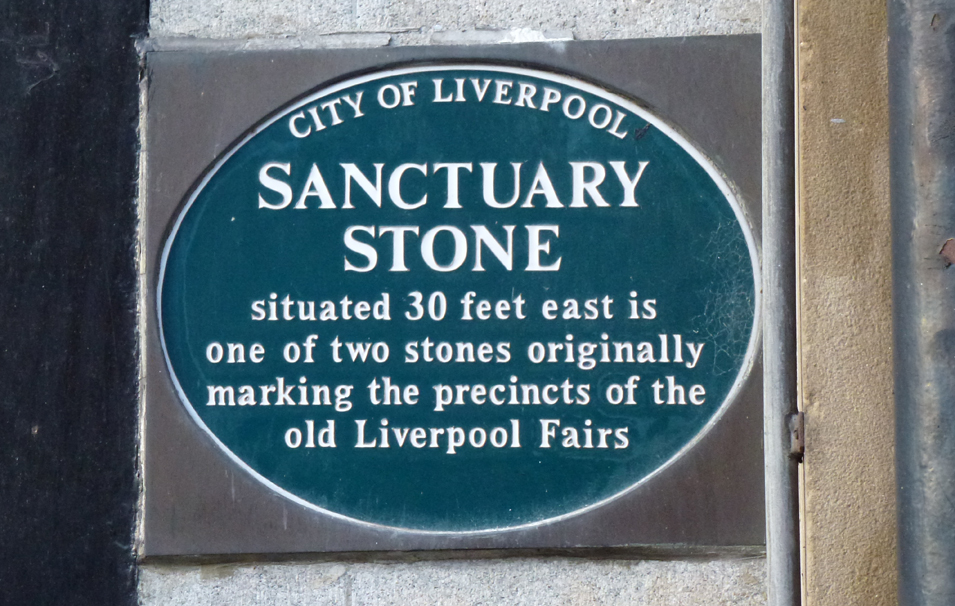
Liz explains: “It’s a darker coloured stone so it does stand out from the pavement and we think it might have originally been one of four small pillars made out of non-local stone to stand out and mark the edges of the Liverpool Fair from the 13th Century onwards.
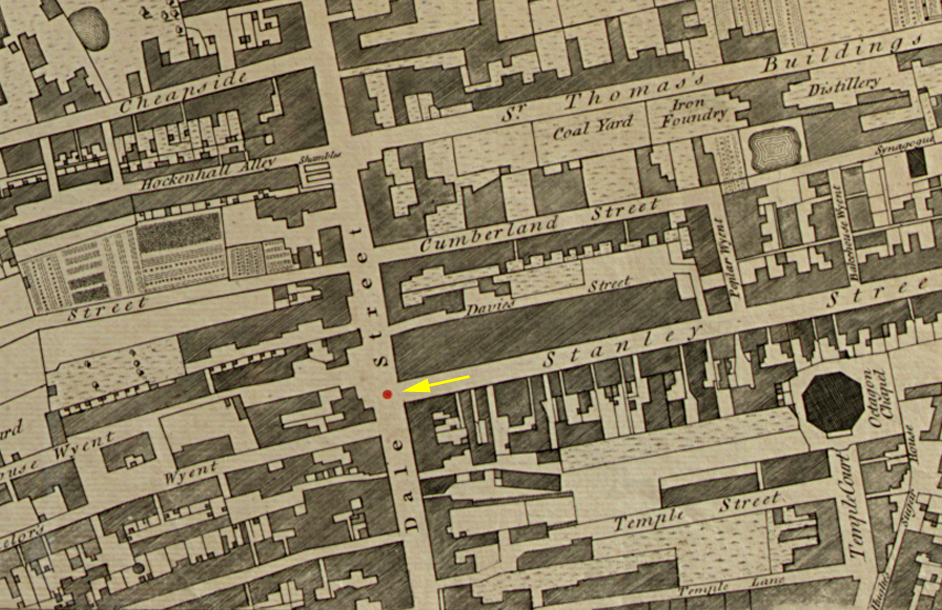
“We know that by the 19th Century there were two left, the other on Dale Street that’s recorded on maps but which was thought to have be destroyed when tramlines were laid.
“We think there were one or two more which showed that area where the market was held and which was right outside where the town hall is now effectively. That’s always been the heart of Liverpool at the centre of the original seven streets of Liverpool – Bank Street (now known as Water Street), Castle Street, Chapel Street, Dale Street, Juggler Street, Moor Street (now Tithebarn Street and Whiteacre Street (Old Hall Street) – and still is the heart of the city now in many ways.”
Liz goes on: “The best historical description of the Sanctuary Stone is by Thomas Troughton who wrote The History of Liverpool in 1810, and he refers back to the 1760s when the tradition of officials walking between these two Sanctuary Stones on Dale Street and Castle Street before going to have dinner at the town hall when the fair was starting up, ended.
“We don’t really know how high the pillars were, but Troughton describes them as small columns that were whitewashed for the occasion. It’s presumed they were a cross-shaft design but we’re speculating really.
“We don’t know what happened to the other Sanctuary Stones – and who knows, the Dale Street one could still be underground? It might be that they’ve been lost as the ground level has risen but we are not entirely sure.”
It’s the more recent repaving of Castle Street that’s placed a new focus on the Sanctuary Stone there and made a feature of it.
Liz said: “It does attract a little more attention than it perhaps once did.”
“One of the challenges of understanding some of Liverpool’s earlier history is that we have so little archaeological evidence. When many of the 19th Century buildings that we primarily see around us were created they dug deep into the cellars, so a lot of it would have been lost at that point.
“There are very few objects of Liverpool history that speak to the Medieval period – we have literally a handful of pieces of Medieval pottery in the archaeology collection that were excavated when they built the law courts at the other end of Castle Street.
“That’s what makes the Sanctuary Stone so special and worth looking out for. It’s a tantalising hint of that bit of early history when the city was essentially a fishing village and these fairs would have been a big feature in the town’s life. It was such a different place to what it is now but would have had a layout of streets that are still recognisable to us today.
“So keep your eyes peeled and look down for it. It’s well worth it.”
Find out more about the sanctuary stone on Castle Street here.
Get the latest news from around Liverpool here.
Find out what’s good up North on our new platform, The Northern Guide.



 Subscribe
 Follow Us
 Follow Us
 Follow Us
 Follow Us
 Follow Us